Overview
The Mission Is the Missing Abstraction made the Mission a durable, approval-backed governance object, and From a Request to an Approved Mission made the approval that creates it trustworthy. Those layers say what was approved, by whom, for how long, and within what bounds. They govern issuance and derivation. They do not evaluate an individual action at the moment it runs.
This part closes that gap. Mission governance makes authority auditable and revocable. Runtime enforcement is what prevents an active Mission from becoming ambient authority. It is the Enforcement step on the spine, and it is the center of gravity for the whole chapter.
A Mission-bound token is as strong as the Resource Server that enforces its bounds. Per-action, parameter-level, and state-aware checks come from runtime enforcement.
This part specifies those checks.
Within a declared enforcement scope, before each consequential action a Policy Enforcement Point (PEP) obtains a permit from a Policy Decision Point (PDP) that evaluates the action against the current Mission. The rest of this part states what that sentence requires.
The decision evaluates the action in its undertaking, not as a bare request priced by a central rules engine. The Mission carries context no resource request ever does: the committed why, the approved shape of the authority, and, because evidence joins on the Mission, what the undertaking has already done. “Delete database” in isolation is indistinguishable from catastrophe. “Delete database, inside an approved migration whose copy steps are already in the Mission’s evidence” is a priced, checkable step. The richer inputs stay deterministic. The anchors and the evidence trail are committed facts, not runtime inferences about intent, which separates this model from the intent-guessing it rejects. The history consulted is also first-party, the deployment’s own record of what its decision points permitted and its enforcement points executed. It differs from the audit layer’s caution that a registered record proves inclusion to an outside verifier rather than occurrence. The PDP trusts its own ledger the way any database trusts its own writes.
The model also fixes an order. Approve the bounded work, then authorize every consequential action against that approved boundary. Per-action authorization alone cannot prevent individually permitted steps from composing into an outcome no one approved. Five reads and one send, each valid in isolation, can be an exfiltration pipeline. The approved boundary bounds that composition only where its bounds are the right kind. A destination the approval never granted stops the send, and the cumulative bounds and single-use permits of Consumption Metering carry the quantitative case. The flow-level residual inside the boundary is covered in the trifecta section. Per-action checks are not information-flow control, and the mitigation for that residual is the harness taint rule, not this gate.
| The control at a glance | |
|---|---|
| Minimum useful version | A PEP at each consequential boundary in a declared enforcement scope obtains a permit from a PDP that evaluates the action, its parameters, the actor, and current Mission state. Fail closed |
| What it prevents | An active Mission becoming ambient authority, and the approved-versus-executed parameter swap |
| What it does not prevent | Misuse inside the approved scope, and anything on a path the deployment does not mediate. Name those paths |
| Operational owner | Platform and resource teams own the PEP fleet. The authorization team runs the PDP as a tier-0 dependency |
| Evidence emitted | Decision Evidence for every consequential decision, including denials, and Execution Evidence for the highest classes |
| Maturity | The Runtime-Enforced bundle’s enforcement half: the runtime core, its OAuth 2.0 profile, the AuthZEN profile, and Runtime Evidence. Consumption Metering is Evaluate only |
The gap issuance leaves open
The issuance profile is an issuance-and-derivation layer, as its own security considerations say. It does not evaluate individual runtime actions, so an active Mission still bounds a set of authority an agent may exercise freely within a token’s lifetime.
Concretely, after the approval event the agent holds Mission-bound access tokens. Each token carries the mission claim and a subset of the Authority Set in its authorization_details. A Resource Server validates the token, enforces the carried authorization_details it understands, and serves the request. That is governance, and for the bounds the Resource Server enforces it is also a control. The token is bound to a kill switch, and the Authority Set is the maximum the token can ever claim. But between approval and the token’s natural expiry, nothing re-checks each concrete action against the current Mission. A compromised, drifted, or prompt-injected agent can spend the whole Authority Set, with any parameters the Resource Server’s own checks admit, as fast as it likes, until the token ages out or someone revokes the Mission.
The runtime layer delivers exactly the four things the issuance profile names as out of scope, plus enforcement of the constraints it carries but does not evaluate:
- evaluation of a request’s parameters against the Mission at the point of use.
- per-action evidence for every consequential action.
- binding the invoked tool or function identity to the Mission’s approved authority.
- execution-time re-evaluation that closes the approval-to-execution gap.
And, additionally, the fail-closed treatment of the consumption bounds a Mission carries, whose definition and metering mechanics live in the experimental Mission Consumption Metering companion.
Mission-bound tokens bound what authority may exist. This profile, the Mission-Bound Runtime Enforcement draft, defines where and how that authority is re-checked before consequential effects occur.
The runtime model
A PEP sits at each consequential execution boundary. Before the action runs, it obtains a decision from a PDP that evaluates the action against the Mission the acting token is bound to. The PDP holds the action inside two bounds at once: the authority the credential itself carries, and the current Mission’s Effective Authority Set. When one of them refuses the action as out of authority or as a parameter violation, Decision Evidence records which one decided.
(action boundary) participant PDP A->>PEP: action + parameters Note over PEP: validate token
(issuer, audience, exp, cnf) PEP->>PDP: evaluate vs Mission
(authority, parameters,
actor, state, resource policy) PDP-->>PEP: permit / deny
(bound to parameters) Note over PEP: reverify binding,
write evidence PEP-->>A: execute / refuse
Two roles do the work, and the spec defines them so the boundary is unambiguous:
- The PEP is the component that can prevent a consequential action and that obtains and enforces a decision before the action runs. Depending on the action it is a Resource Server, an MCP server, an egress proxy, a workflow engine, or the orchestrator itself.
- The PDP evaluates the action against the Mission and returns permit or deny. Its placement is a deployment choice: co-located with the Mission Issuer, embedded in the Resource Server, a tenant-scoped service, or a shared service. The profile mandates none of these. It requires only that a PEP at each consequential boundary can reach an applicable PDP.
Two more parties own steps around the decision. The issuer derives authority and serves Mission state, and the resource executes the effect. The steps from request to effect, with the owner of each (the member names, denial reasons, and record identifiers are the AuthZEN profile’s or extensions it admits):
| Step | Owner | Input and its source | Check | Failure reason or record |
|---|---|---|---|---|
| Derive authority and serve state | Issuer | The approved Mission record, held by the Mission Issuer under the OAuth binding or by a standalone MAS | Under the OAuth binding, each token’s entries are a subset of the Effective Authority Set and its exp is capped at expires_at. Under a standalone MAS, the unchanged AS mints ordinary tokens. Either issuer reports lifecycle state and every narrowing | Under the OAuth binding, derivation is refused unless the Mission is active |
| Validate the credential | PEP | The presented token and its proof of possession. The boundary identifier comes from the PEP’s trusted routing, never from aud | Issuer, expiry, sender constraint where the token is bound, and an aud that names the boundary | Refused before any decision. Refusal Record token_invalid |
| Name the Mission | PEP | The token’s mission claim. Under a standalone MAS, the PEP’s own Mission binding or configuration, or the request’s Mission-Reference field or MCP params._meta reference | One Mission reference, with no source naming a different Mission | Refusal Record mission_claim_missing where the binding requires the claim. mission_reference_conflict for a propagated reference that conflicts with another source, is malformed, or is missing |
| Establish the operation target | PEP | The resource’s trusted operation contract and the validated arguments, never the token’s entries, the Mission’s entries, or a caller-asserted value | One unambiguous target | Refused before any decision. Refusal Record target_unresolvable |
| Join the credential to the Mission (standalone MAS) | PDP | The Mission’s subject and client_id from the MAS’s Mission Status response, and the credential’s authenticated subject and client | Subject and client match under the mapping contract, or a Mission Join Assertion verifies | mission_binding_failed, with no fallback to the Mission’s authority |
| Authority | PDP | The credential’s own entries in context.credential.authority, and the Effective Authority Set from a state source that reports narrowing | The action, matched on the operation target, falls within an entry of each bound. The capability identity is in actions, a catalog capability’s definition digest is unchanged, and a pinned resource contract resolves | out_of_authority or parameter_violation, with authority_bound naming the bound that refused. credential_invalid, capability_drift, resource_contract_drift, or the narrowing mechanism’s own reason |
| Parameters | PDP | The concrete parameters, and every constraints value on the applicable entry | Each constraint holds | parameter_violation. constraint_unsupported for a constraint the PDP cannot understand or enforce |
| Actor | PDP | Authenticated actor and delegation evidence. Under the OAuth binding, the token’s act chain and client_id. Under a standalone MAS, the deployment’s actor records for the joined party | When delegation is in effect, the evidence is present and well formed, and client_id alone is not taken as the immediate actor. Under a MAS, delegate depth is evaluated from the actor records | actor_invalid. Under a MAS, a delegate with no actor record under the Mission fails the join with mission_binding_failed |
| Time | PDP | The credential’s expiry, and any Mission expiry a state source reports | Neither has passed | credential_invalid for an expired credential. mission_inactive for a passed Mission expiry |
| State | PDP | The Mission state source, within the published staleness bound | The Mission is active | mission_inactive. stale_state when the PDP cannot establish state within the bound |
| Resource policy | PDP, the resource, or both | Object-level authorization, tenant configuration, legal holds, service invariants, and risk policy | Resource policy permits the action | resource_policy |
| Action-bound approval, where required | PDP | The approval the workflow returns, carried as context.approval | A fresh approval bound to this action and its parameters | approval_required |
| History (optional) | PDP | The Mission’s prior Decision and Execution Evidence, within its staleness bound | Each required predicate holds | history_not_satisfied |
| Issue the permit | PDP | The evaluated request | Binds the permit to the parameter_digest, sets valid_until, and sets use_limit: 1 for the high-consequence classes. For an irreversible action, external commitment, or privileged administration, claims the idempotency key atomically before issuing the permit. For a reversible consequential write, the PDP makes no claim | duplicate_suppressed or idempotency_conflict for a claimed key. Decision Evidence for every permit and denial |
| Reverify at use | PEP | The permit’s echoed conditions, the parameters it is about to use, and the operation target re-established from the operation contract | Recomputes the digest, keeps the consumed-identifier store, and honors every condition present. An unrecognized condition invalidates the permit | Effect suppressed. Execution Evidence suppressed with an error such as parameter_mismatch, target_drift, permit_consumed, or condition_unrecognized |
| Execute | Resource | The request the PEP releases | Performs the effect. Where it claims conditional-effect support, it compares the bound version atomically with the effect. Under durable idempotency, it deduplicates a retry under the same key. A reversible consequential write’s key is deduplicated here or by the enforcing PEP, because the PDP does not claim it | The PEP’s Execution Evidence records completed, failed, or suppressed. An outcome not yet known goes to reconciliation |
The runtime decision evaluates six required inputs against the action, plus an optional seventh, and a deny on any one is terminal for that action:
- Authority. The action must fall within two bounds, the credential’s own authority and the Mission’s current Effective Authority Set. The PDP never substitutes the approved set for a credential’s narrower authority.
- The credential’s authority follows the subset rule. It is an applicable
authorization_detailsentry the token carries, or one available to the PEP or PDP for that token through introspection. - Under a standalone Mission Authority Server, the token is ordinary and carries no Mission. The PEP supplies the Mission reference from its own Mission binding or deployment configuration, or from the request. A request names its Mission through the
Mission-ReferenceHTTP request field (identifierid) or the Mission reference in MCPparams._meta(thecom.karlmcguinness.mission/referenceobject, identifiermission_id). The reference is a selection channel only. It carries no state or authority. The PDP binds the token to the Mission through a join (a mapping join or a Mission Join Assertion), and a failed join is denied asmission_binding_failed. The credential’s own bound is then the authority its verified scope maps to under the deployment’s mapping contract. - Where an Authorization Server redeemed a standalone MAS’s issuance grant, the token is Mission-bound and carries its own entries, as under the OAuth binding.
- The Effective Authority Set is the approved set less any discharge or containment. A narrowed Mission stays
active, so the PDP learns the effective set within the staleness bound from a source that reports narrowing, not lifecycle state alone. - In both bounds, a
mission_resource_accessentry’sresourceis matched against the operation target the PEP establishes from its trusted operation contract. It is never matched against the audience, which identifies the enforcement boundary. - The PEP asserts the capability identity it will invoke, and the PDP refuses an identity outside the approved
actions. A catalog-sourced capability is further bound to the digest of its definition recorded at derivation (covered byauthority_hash). If a tool definition is later redefined or poisoned, the digests differ and the decision fails closed ascapability_drift, under the extraction rule Mission Capability Binding owns (the adversary model gives the approval-time check). - A resource can also change the meaning it gives an action and its parameters while every name stays the same. An entry can therefore pin a resource contract, an immutable reference the AS records before approval and
authority_hashcommits. The PDP deniesresource_contract_driftwhen that reference does not resolve to a contract the resource still performs.
- The credential’s authority follows the subset rule. It is an applicable
- Resource policy. A Mission-bound permit is an upper bound on authority, not a command to perform the action. Object-level authorization, tenant configuration, legal holds, service invariants, and risk policy still apply. The action fails closed unless both Mission authority and Resource policy permit it.
- Parameters. Every
constraintsvalue on the applicable entry is evaluated against the concrete parameters. A constraint the PDP cannot understand or enforce causes refusal, never silent pass-through. - Actor. When delegation is in effect, the PDP evaluates authenticated actor and delegation evidence and refuses evidence that is missing or malformed. Under the OAuth binding that evidence is the token’s
actchain (the delegation chain is Mission-Bound Authority). Under a standalone MAS it is the deployment’s actor records, not a Mission-bound token’sactchain. The PDP evaluates delegate depth from those records, and a delegate with no actor record under the Mission fails the join withmission_binding_failed.client_id(the client that obtained the token) and the immediate actor (the current actor inact, or that client when there is no chain) are distinct inputs, and the PDP never treatsclient_idalone as the immediate actor when a chain is present. - Time. The PDP refuses an expired token. Because the issuance profile caps a derived token’s
expatexpires_at, theexpcheck transitively enforces Mission expiry, and the PDP also refuses when a state source reports the Missionterminatedwith reasonexpired. An optionalexpires_aton themissionclaim never extends reliance. - State. The PDP refuses unless the Mission is
active. This is the handbook-wide rule made operational. Onlyactivepermits reliance, and every other state, recognized or not, is non-active. - History (optional). A deployment may evaluate policy predicates over the Mission’s prior Decision and Execution Evidence, for example that a named action class has completed. History is a decision input, never a grant, and a required predicate the PDP cannot establish within its staleness bound fails closed.
This makes Intent-Based Access Control practical. The PDP checks a concrete action against an approved, integrity-anchored Authority Set and does not reconstruct “what did the user want” from a prompt at enforcement time. The interpretation already happened at consent time (The Mission Is the Missing Abstraction). Current resource policy stays authoritative for the final permit or deny.
The model has a cost, because the decision sits on the hot path. Every consequential action takes a policy evaluation. The contract’s cost controls are the classification and the lease: non-consequential work is never gated, consequential reads take a decision without parameter binding, permits for reversible writes amortize across a validity window, and only the high-consequence classes pay for single-use permits and reverification on every execution. The family has no deployment-scale performance data yet, and this handbook does not estimate it. A deployment should publish its measured decision latency next to its staleness bound. Those numbers have to come from running systems, which is one more reason the Runtime-Enforced level ships before the roadmap. The classification bet names the erosion to watch while they arrive, a mediated class list that shrinks release over release while the claim name holds.
What the resource will actually do
An agent works for Alice under a Mission whose payments entry lets it pay invoices from the vendor acme, with a max_amount of 500.00 USD. The agent asks to pay invoice inv-1 and supplies only the invoice identifier and an idempotency key. The payments store resolves the rest. The invoice is from acme, is for 125.00 USD, and pays the account acct-acme.
Authorizing that request makes the payment safe only when the system also knows which effect the payments resource will perform and which guarantees the resource can enforce. The resource declares both in its operation contract and Operation Profile, and the digest and permit machinery later in this part binds a decision to those declarations. The example turns on five distinctions, each with its own mechanism:
| Distinction | What goes wrong without it | What handles it |
|---|---|---|
| Token audience versus operation target | Matching the entry against the token audience can authorize the wrong operation target behind the same API, even when the action name matches | The PEP sets the boundary from its own routing and checks the audience against it. It derives the operation target from the operation contract and the validated arguments, then matches entries and executes on that target alone. The two roles stay separate even when the strings match (the Authority input, the AuthZEN mapping) |
| Credential authority versus current Mission authority | A token minted before containment or discharge removed the payments entry still carries it, so a check of the token alone would pay | The action must fall within both the credential’s own authority and the Mission’s current Effective Authority Set. Neither substitutes for the other, and Decision Evidence’s authority_bound names the one that refused (the Authority input, denials) |
| Approved parameters versus resource-resolved facts | If max_amount read an amount the agent supplied, the agent would choose the number the approval bounds. If the resource changed what a payment does under unchanged names, the approval would cover an operation nobody reviewed | The Operation Profile maps max_amount to the store’s amount and digests every field that shapes the effect, the resolved amount and payee included. A resource contract pins the meaning the entry was approved under, and the resolved facts stay live inputs (the Operation Profile) |
| Checking context versus enforcing it atomically | The vendor’s payee account changes after the decision, and the payment goes to the new account | The executing PEP rereads the resolved facts and recomputes the digest before release, which catches a change up to that reread. Evaluation-Context Binding formalizes that reread for declared facts as its verified property, and its enforced property needs the resource to compare the bound version atomically with the payment (Evaluation-Context Binding) |
| Consuming a permit once versus producing an effect once | The payment times out after the permit is spent, and nobody knows whether money moved. A retry on a fresh permit could pay the invoice twice | A single-use identifier stops one permit from executing twice, and the PDP’s atomic claim on the idempotency key stops a second permit for the same request. Recovering from the lost response needs a declared outcome lookup, which settles the outcome from evidence attributed to the action, or durable idempotency at the resource, which deduplicates a retry under the same key. Without either, the outcome stays undetermined and nothing pays again (lifetime control, reconciliation) |
The drafts repository’s reference payments resource runs this example (its walkthrough). It claims Evaluation-Context Binding for payment execution at the verified property. A payee change between the decision and the PEP’s reread moves the bound context, and the attempt is suppressed as target_drift with no wire. It does not claim the enforced property, because its reread and its ledger insert are separate steps, and it names a change after the reread as a residual. An idempotency key identifies one request and not the business event, so its ledger settles each invoice at most once under any Mission or key within one running instance, because the reference ledger is simulated in memory. It claims no exactly-once execution. Its stack requires no action-bound approval for the wire, the step Chapter 2’s deployment adds.
Which actions are consequential
The PDP gate is not for every action. Reasoning steps and cache reads have no external visibility and need not be gated. The boundary between consequential and non-consequential is deployment policy. But a deployment must not draw it so loosely that nothing is enforced. The profile defines a default classification a deployment SHOULD adopt, and a floor it MUST observe.
| Class | Examples | PDP gate | Parameter binding |
|---|---|---|---|
| Non-consequential | internal reasoning, cache reads, planning | not required | n/a |
| Consequential read | reading user data, querying logged APIs | MUST | not required |
| Consequential write | updating records, posting messages | MUST | MUST |
| Irreversible action | sending mail, payment, deletion | MUST | MUST, with TOCTOU reverification + evidence |
| External commitment | signing, accepting terms for the user | MUST | MUST, with TOCTOU reverification + evidence |
| Privileged administration | granting access, changing policy | MUST | MUST, with TOCTOU + evidence |
The bottom three rows are the high-consequence classes, where a token-lifetime-wide standing authority is least appropriate and the profile’s strictest requirements attach (action-bound approval, mediated custody, active-state freshness, execution-outcome evidence, all below).
One property cuts across the classes. An external-communication action is a consequential action of any class whose effect carries data to a recipient outside the deployment’s trust boundary: sending a message or mail, posting to an external service, publishing. It names the egress property, not a further class. The action keeps its class and that class’s requirements, and the rules stated over external-communication actions (the taint rule, trifecta containment, egress metering) apply to every action that has the property.
Two guardrails constrain classification. A Mission’s purpose, or deployment policy, MAY raise an action to a stricter class. A financial-settlement purpose may treat a write as an external commitment. It MUST NOT lower an action below the resource owner’s minimum, and MUST NOT classify an irreversible, external-commitment, or privileged-administration action as non-consequential. A deployment cannot evade enforcement by relabeling a high-consequence action as harmless.
The classes are floors drawn from several consequence dimensions, reversibility, exposure, privilege, commitment, and value, with policy taking the maximum across them, because a read of regulated data cannot be undone once the data leaves. The same operation can also cross classes on its parameters, so creating a ten-dollar draft and releasing a million-dollar transfer can fall in different classes.
The table’s gate column applies within the declared runtime-enforcement scope. Outside it, an issuance-gated path claims its published worst-case credential-lifetime bound, including the age of any observation used to mint the credential, and a path outside Mission enforcement gains no Mission revocation guarantee (not every resource checks Mission state). Classification is deployment policy above the floor. One exception covers reads. A read already fully constrained by the token’s audience and resource and the Resource Server’s object-level authorization, with no material effect on the resource set or disclosure risk, need not be classed a consequential read, so the profile does not require every read to reach a PDP. The exception concerns classification only. Writes and higher classes are gated as the table requires. Neither classification nor a scope exclusion supports a claim for enforcement the path does not provide.
Where the enforcement point sits
The same Mission, PDP, and policy view all fail if the permit is checked somewhere the action can route around. Five rules govern placement:
- The PEP MUST be at the last controllable boundary before the action. A permit checked further upstream does not survive parameter changes, retries, or routing that happen after the check.
- A token-issuance decision does not replace execution-time authorization. A token-only Resource Server cannot claim runtime enforcement. The issuance gate is governance. The runtime gate is enforcement.
- A tool-catalog filter does not replace per-call authorization. Filtering a
tools/listby the caller’s authority is exposure control. Every consequentialtools/callstill passes the runtime gate. - An orchestrator’s internal check does not replace a Resource Server’s PEP. It may add defense in depth, but it never substitutes for the PEP.
- If no PEP can prevent the action for a class, the deployment MUST NOT claim runtime enforcement for that class, and must name the classes and execution paths it does mediate.
That last rule is why the profile’s conformance is scoped, not global. A deployment conforms only for the resources, action classes, execution paths, and authorization-detail types named in its enforcement scope. An OAuth-protected API call is gated at the Resource Server, a consequential MCP tools/call at the MCP server, a local file write or payment at the orchestrator, external egress at an egress proxy. Where an action can be reached by an unmediated path (a debug shell, an unsanctioned egress route, a direct connector), the profile is not enforced for the classes that path reaches, and the claim must say so.
The claim, as a surface a deployment would publish:
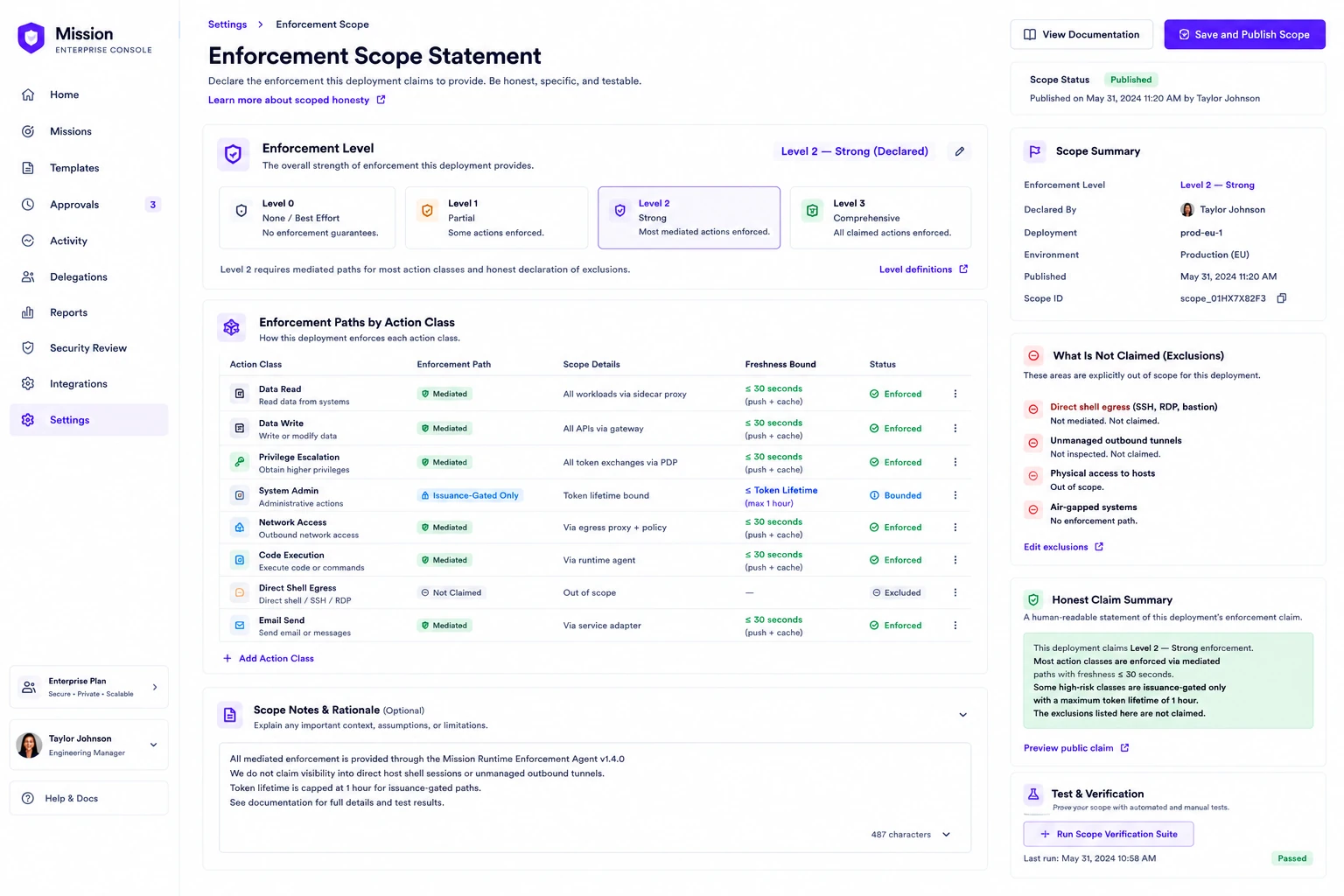
The parts worth copying are the first-class exclusions, the token-lifetime bounds on issuance-gated classes rather than a pretense of mediation, and the verification suite. The mock’s enforcement levels are this deployment’s own declared strength scale, not the Mission Assurance Levels.
The deployment question underneath is what can be centralized and what must live at each boundary. The PDP centralizes, with one decision service (or a small fleet) serving every PEP. The PEPs cannot, because a permit is only as good as its placement:
| Boundary | Who runs the PEP | Centralize? | What it can gate |
|---|---|---|---|
| Resource Server or SaaS API | The resource’s own authorization layer | No, one per resource | The strongest placement: Mission permit and object-level resource policy at the point of use |
| API gateway or egress proxy | The platform team | Yes, one gate fronting many resources | HTTP egress and the APIs it fronts, with parameter binding for what the gateway can see |
| MCP server | The tool host | Yes, per tool host | Every consequential tools/call and its arguments |
| Agent harness or orchestrator | The runtime team | No, local to the runtime | Local side effects no network gate ever sees: file writes, shell, spawn, resume |
| Privileged tool broker | The mediating PEP under mediated custody | Yes, for the mediated classes | High-consequence actions a compromised agent must not reach directly, because the broker holds the sender-constraint key |
A real deployment mixes rows, and the enforcement-scope statement records which rows it runs.
Closing the TOCTOU gap with parameter binding
A permit for an operation does not authorize arbitrary parameter values. If the PDP permits “write to the ledger” and the agent then changes the amount, the permit must not still hold. This is the time-of-check-to-time-of-use (TOCTOU) gap, and parameter binding closes it.
For consequential writes and the high-consequence classes, the PDP binds its permit to the normalized action parameters through a parameter_digest. The permit also binds the full set of authorization-relevant inputs it was decided on, which the runtime core lists, and a tight lifetime control.
The executing PEP, not an upstream component, recomputes the digest against the parameters it is about to use, immediately before acting, and verifies every binding. A mismatch refuses. The permit does not authorize the changed parameters. Two consequences follow:
- A permit cannot be replayed for a different request, because the digest mismatches.
- A permit cannot be reused across boundaries. Bound to a specific boundary identifier, operation target, tenant, and operation, a decision for one is not reusable at another, which is the confused-deputy defense.
What the PEP checks, and how. The AuthZEN permit echoes only the bindings the PEP enforces at each use (the reverification row of the runtime model’s table):
- The
parameter_digest, which the PEP recomputes. valid_until, never later than the credential’s expiry, the approval’sapproved_until, the state’s valid-through time, or the policy maximum.use_limit, which the PEP enforces from its own consumed-identifier store.- The evaluation-context digest, where Evaluation-Context Binding is claimed.
- The action phase, where the operation is a phase of a compound action.
- The resource contract reference, where a resource contract applies.
- The work item, where the request carried one.
A condition the PEP does not recognize invalidates the permit. The other bindings (issuer, boundary identifier, operation target, sub, client_id, actor, key, entry, and policy view) are not echoed. They hold because the PEP built the request from its own validated credential context and took the boundary from its trusted routing, never from the token’s aud. The requester and the executor must also be the same enforcement identity on one mutually authenticated channel. A permit is never relayed to another component as a bearer grant, and a cached permit does not serve a request whose cache key differs. At use, the executing PEP re-establishes the operation target and suppresses the effect as target_drift when it differs from the target the permit was evaluated for. It also re-resolves any resource contract reference and refuses before any effect unless the reference resolves to the contract the permit was decided under. Beyond the target, the drafts specify no field-by-field comparison for the bindings the permit does not echo.
The lifetime control scales with risk. A reversible write may use a single-use decision identifier or a short window plus an idempotency key. An irreversible action, external commitment, or privileged administration MUST use a single-use decision identifier (a validity window alone does not bound how many times such a permit executes), and consumed identifiers are recorded so any second presentation fails closed. A single-use identifier bounds executions of one permit, not permits for one action, so for a non-idempotent operation in these classes the Operation Profile MUST also define an idempotency key, which identifies one intended execution of one normalized request. The PDP claims the key atomically before it permits. A repeat under the same key and the same operation is duplicate_suppressed (retryable while the first outcome is unresolved, and once it completes the resource returns the prior result rather than executing again), and the same key with a different operation is a terminal idempotency_conflict. An intentional re-execution is a new operation under a new key, which an action-bound approval can authorize as such. The claim needs an exact store (a single serializing PDP or a linearizable shared store), so a deployment whose replicas only converge within a bound cannot make it. And these classes MUST carry an execution lease or a published maximum execution duration, so run-to-completion is bounded too. Idempotency support, reversibility, and the lease an operation needs are resource-declared semantics, stated in the Operation Profile the deployment publishes for each operation so the PDP does not guess. The same profiles mark compound actions. An action that crosses more than one boundary (reserve then commit, draft then send) obtains its own Decision for each consequential phase, each permit binds its phase, and a prepare-phase permit never releases a commit.
The Operation Profile. Normalization is the Operation Profile’s job, so that two implementers of one operation bind the same bytes. The digest is computed directly over the normalized parameter object, with no envelope, under the issuance profile’s canonicalization rules. The runtime profile requires each Operation Profile to fix:
| The profile fixes | What it settles |
|---|---|
The action identifier and its mapping to resource | Which approved entry the action is checked against |
| The parameter schema, default insertion, omitted optional fields, and set-like arrays | The bytes before canonicalization |
| Exactly which fields enter the digest | Every field that influences the external effect enters, and an excluded field must be shown effect-free |
| Each constraint’s input, extraction and normalization mapping, fail-closed behavior, and fixtures | How the PDP reads the parameters against the entry’s constraints |
| Whether the operation is part of a compound action, and its phase | Which permit each phase needs |
| Single-use identifier or validity window with idempotency key, whether an execution lease is required, and the evidence fields | The lifetime and evidence declarations, stated even where the answer is no |
| Digest test vectors, one exercising a normalization rule, and a failing-digest case | How a second implementer checks the bytes |
| Where the transaction-assurance tier covers the class, the execution capabilities: durable idempotency, conditional-effect support, outcome lookup, commit point, cancellation, and compensation, each stated even where the answer is no | Which transaction claims the operation supports. The enforced property of Evaluation-Context Binding needs conditional-effect support, exactly-once execution needs durable idempotency held by the resource, and an unknown high-consequence outcome is never recovered by running the effect again, except under the same key at a resource whose durable idempotency deduplicates it |
A deployment that leaves any of these unstated has not specified that operation’s binding. The drafts define no wire format or registry for Operation Profiles. A resource can still fix this material for an approval as a resource contract, which assembles each covered operation’s operation contract and Operation Profile definitions, and the PEP then normalizes and performs the operation under exactly the version the entry pins. The contract leaves the resolved facts live (the payment example) and the canonicalization limit below in place.
Two limits bound what the digest can promise, the resolved-fact and single-effect distinctions of the payment example. Where a resource resolves material semantics after receipt, the PEP hashes a phrasing of the action rather than the action the resource executes. A single-use identifier guarantees single consumption, not single effect. The repair for both moves the binding to the effect: a resource-prepared descriptor authorized and committed exactly once, or a mediating handler that is the transaction’s system of record.
Consequential reads do not require a digest by default. But a binding floor applies. A read whose parameters select a cross-tenant or cross-audience scope, request a bulk or export-like result, or choose the returned fields or destination MUST bind those parameters. An export is not an ordinary read.
The running example. Take the handbook’s running example, the Prepare the Q3 board packet Mission. A
query_financialsread againstfinance.example.comis a consequential read. The PDP permits it against the live Mission, no digest required. Anotify_reviewersend againstworkflow.example.comis consequential and externally visible, so its permit is bound to the concrete recipient, theaudit-committeegroup named in the entry’sconstraints. Ask to notify a target outsideaudit-committeeand the action is outside the Authority Set’s constraint. The PDP refuses (parameter_violation) and the PEP fails closed.
Metering, and fail-closed on everything else
A Mission can carry cumulative consumption bounds (max_budget, max_calls, max_duration, max_egress_volume), and the issuance layer cannot enforce them because it counts derivations, not actions. The bounds and their metering mechanics are defined by the experimental Mission Consumption Metering companion. The runtime profile keeps the fail-closed posture, so an unknown or unmetered bound on an applicable entry refuses. Under the companion, the PDP reserves or charges each consequential action atomically against its bounds and refuses when a bound would be exceeded.
Metering is a two-phase exchange, not a single decision-time act. For an action of unknown length the PDP reserves a bounded maximum or issues a duration lease, and the Execution Evidence record (below), keyed to the permit’s evaluation_id, commits actual use and releases the unused reservation. For irreversible actions and external commitments, a deployment must define whether metering is reserved before execution and committed after success, or committed up front. When the permit is spent and the resource has not answered, as with the lost payment response in the payment example, evidence records the outcome as unknown rather than guessed. The unknown has an owner, a named reconciliation against the resource with a deadline, so that no unknown outcome is silently dropped. Reconciliation records an outcome only from evidence the resource attributes to the action through an identifier recorded with the effect, such as the evaluation identifier, the idempotency key, or a provider operation identifier. Resource state alone, such as an invoice now shown as paid, can have another cause and leaves the outcome undetermined. An unknown’s reservation stays charged until it is reconciled and is released only on affirmative evidence that the action did not execute, never on a timeout. Reconciliation never admits a new effect under a Mission that has since gone non-active.
The topology is part of the claim. Under a single serializing PDP the check-and-decrement is atomic and the bound is exact. Under distributed PDPs an exact global counter is a distributed-counting problem. Such a deployment either keeps the bound exact by splitting the cap into per-PDP sub-budgets that sum to it, or publishes the consistency bound it operates under (a bounded reconciliation window), and must not advertise exactness it cannot meet. Cumulative-bounds enforcement is a newer model, which is why the companion is experimental, with short expiries and per-action constraint checks as the path to start with.
Enforcement is only meaningful if failure is bounded, so the spec fixes the failure behavior. For consequential actions, when the answer is in doubt, refuse. The rows below are an excerpt. The draft’s failure-mode table is longer, and its further rows, such as a missing mission claim or an unsupported authorization-detail type, refuse the same way.
| Condition | Required behavior |
|---|---|
| Token validation fails (including sender-constraint check) | Refuse before runtime evaluation |
| PEP–PDP channel authentication or integrity fails | Fail closed |
| Mission state cannot be established within the staleness bound | Fail closed for consequential actions |
| PDP unreachable | Fail closed for consequential actions. Do not proceed on cached permits past the window |
Mission not active | Refuse |
| Unknown or unmetered constraint on the applicable entry | Refuse |
parameter_digest mismatch at the executing PEP | Refuse |
| Re-presentation of a consumed single-use decision identifier | Refuse |
| Request would broaden the Mission’s authority | Refuse (expansion is out of scope here) |
parameter_digest covers the request’s own fields and cannot freeze the target. A document can be revised, a record reclassified, a payee account changed (the payment example), or a query can return a different set by the time the action lands. For high-consequence classes, treat that as a named residual unless the deployment claims the extension below. The permit’s tight lifetime is the bound, a retry re-evaluates rather than replaying a stale permit, and where the resource exposes versions or content digests, bind them as request parameters so the parameter_digest carries them. The runtime core also defines an optional Named Assurance Extension, Evaluation-Context Binding, claimed per mediated class. The Operation Profile declares which resource-resolved facts a decision depends on (a revision, or the enumerated resolved values), the PEP captures them from their authoritative source and commits them in an evaluation_context_digest the permit returns as a condition, and the executing PEP re-resolves and recompares them in the same step as the parameter_digest check. The PEP refuses when it cannot capture the context before the decision. After a permit, a mismatch suppresses the effect and is recorded as target_drift, or as parameter_mismatch where the context was established and an agent-supplied parameter changed. The binding commits a versioned descriptor of the facts and a secret salt, and a binding whose salt or descriptor cannot be recovered is refused before any effect. A reread earns the verified property, and the enforced property needs declared conditional-effect support.
Every permit, and every refusal at an established enforcement boundary, produces a runtime evidence record sufficient to reconstruct which path produced it. A PEP that cannot establish the boundary refuses without one, because every record names a boundary, and the deployment logs that refusal by its own means.
Fail-closed and active freshness
The high-consequence classes turn the “Mission not active” row above into a hard requirement on the state source. A token alone cannot tell the PDP the Mission’s current state. The token was minted at approval time. So the deployment must define a Mission state source it trusts, and the PDP must refuse a consequential action when it cannot establish, within a published staleness bound, that the Mission is active.
A permit is a lease, not a standing grant. Token TTL, cached Mission status, and policy views are all leases on Mission authority, each valid for a bounded window before it must be refreshed against the state source or fail closed. Each enforcement scope publishes its staleness bound together with the latency consequence that bound carries. For a PDP-gated class, a revocation takes effect, worst case, after the staleness bound plus the permit validity window plus the class’s execution bound. For a path outside PDP gating, the bound is the token lifetime where the token’s minting checked current Mission state, and otherwise the token lifetime plus the age of the state observation it was minted from. Each bound fixes how long after a revocation new effect can begin. How much effect occurs inside it depends on the deployment’s admission rate, bursts, and concurrency, and on the actions already in flight, each of which may run to completion.
The TTL-only end of that dial is a first-class posture, not a fallback. A path that relies on lifetimes alone verifies with local cryptography and a clock, with no state source to couple to and a worst-case exposure equal to the lifetime by construction. A lifetime alone cannot make a suspension, completion, or revocation take effect before the token expires. It moves the freshness check from the verification path to the issuance path.
Most estates will start at the coarse end of that dial, and the handbook meets them there. Short-lived tokens minted under state-gated issuance are a legitimate setting for the classes below high-consequence. The resource validates tokens as it does today, with no PDP call and no Mission awareness, and revocation still reaches it within the token lifetime where every issuance, refresh, and exchange path checks Mission state when it mints. A token minted from an earlier observation, such as a grant redeemed later, adds that observation’s age to its lifetime. A legacy resource that will never evaluate Mission state is served that way, or fronted by a gateway or MCP PEP that carries the per-action check on its behalf. The Reference’s revocation matrix gives the exposure of every setting on the dial, and Adopting carries the deployment shapes. The high-consequence classes still require an active freshness mechanism, and a path whose only bound is token lifetime states that bound in writing.
For the high-consequence classes the spec is categorical. The state source MUST be an active freshness mechanism that can reflect a revocation within the staleness bound, queried or pushed independently of the token’s own lifetime. On the OAuth 2.0 profile that is token introspection at the Mission issuer, the Mission Status surface, a Mission Status List whose Status List Token TTL is within the staleness bound (the pull floor for consumers relying on many Missions at once), or Lifecycle Signals (Mission Lifecycle and Change). It must also report any discharge or containment narrowing.
Token-lifetime expiry alone is not an acceptable state source for the high-consequence classes. It bounds staleness only by the token lifetime, so a revoked Mission keeps deriving consequence until tokens age out, which is the ambient-authority gap this profile exists to close.
The runtime draft recommends a default freshness posture per class, adopted absent a documented, consequence-specific analysis:
| Class | Recommended freshness posture |
|---|---|
| Consequential read | Token lifetime or a short state lease; tighter for privacy-sensitive, cross-tenant, or bulk reads |
| Consequential write | A short state lease, typically measured in minutes |
| Irreversible action | An active source; an immediate check or a single-use permit, with a target under 300 seconds |
| External commitment | An active source; an immediate check or a single-use permit, plus an egress PEP for external communication, with a target under 300 seconds |
| Privileged administration | An active source; an immediate check suitable for composition with local step-up, with a target under 300 seconds |
A deployment justifies any looser value for a high-consequence class in its enforcement-scope statement. These are targets for the freshness of the state a decision reads. The worst-case revocation bound adds the permit and execution windows above. The reference target the drafts repository builds first configures 300 seconds for reads and writes, 60 for external commitments, and 30 for irreversible actions and privileged administration (its deployment record).
Here the handbook-wide rule “only active permits reliance” becomes a wire requirement. A suspended Mission, or one terminated for any reason, produces a mission_inactive denial regardless of policy, and for the actions that matter most, the deployment must be able to learn the revocation fast enough to act on it.
Where the PDP gets the narrowed set. The PDP may evaluate a materialized policy view or the Mission’s recorded authority, but mutable state, including every narrowing of the Effective Authority Set, comes from a state source within the staleness bound, never from that representation. A source that reports only lifecycle state does not qualify, because a narrowed Mission stays active. On the OAuth 2.0 profile the qualifying sources are full Mission Status or introspection carrying containment_version, and Lifecycle Signals carrying the overlay change. A Status request that names an audience returns the entries relevant to that audience after every narrowing. One that omits it is state-only, which is all the harness needs at 02:00 and not enough for a PDP evaluating authority. The AuthZEN profile defines no member that carries the evaluated set.
The high-assurance level
Everything above bounds what any agent can do. The high-assurance level raises the bar for a compromised agent, one that has been prompt-injected or taken over but still presents correct credentials. The issuance and runtime gates do not make the agent trustworthy. They bound what it can do. This level shrinks that bound further by not letting the agent hold the authority whose misuse is unacceptable, and by requiring a fresh independent approval for the highest-consequence acts.
Mediated custody. For any class a deployment mediates, and for every high-consequence class, the acting credential must be sender-constrained, so that only the holder of the private key its cnf binds can present it. For the mediated classes, the PEP holds the sender-constraint private key, not the agent. The agent cannot present the credential directly. To act, it asks the mediating PEP, which runs the decision and only then uses the key. This needs no new token type or wire protocol, only a custody-and-placement property of the existing key. The token is unchanged, the agent remains the principal of record (client_id still attributes the action), and no act entry is added. Two properties follow: a credential exfiltrated from a compromised agent is unusable without the key, and a compromised agent cannot reach a mediated action without passing the per-action check, because it never holds a usable credential for that class. This depends on the agent having no unmediated path to the resource, which the agent harness establishes (The Agent Runtime and Audit).
The drafts do not specify which component makes the token request. In one shape they describe, the PEP is itself the attested instance that obtained the token, with the key generated in the PEP or its HSM, and the declared path scope leaves the agent no token, refresh, or exchange path to a usable credential of its own.
Action-bound approval. The Mission’s approval event consents to the task and its authority bound. It does not consent to a specific action’s concrete parameters. An action-bound approval is a second, fresh approval for one action, and these rules govern it:
- What it binds. It is bound to the concrete action and the parameters the PEP is about to permit, and to the resource contract reference where one applies. Because it is bound to the parameters, it is reverified under the same TOCTOU rules as the permit, and a parameter change after approval invalidates it.
- When it is required. A deployment can require it for the high-consequence classes. An Authority Set entry can also demand it through the
requires_action_approvalCommon Constraint the Resource Access Profile defines. Where it is required and no valid fresh approval is present, the action is refused (approval_requiredin the AuthZEN profile). - Who may resolve it. An independent Approver or policy authority resolves it, and the agent never self-issues it. This handbook recommends a human decision for the high-consequence classes. The surface that resolves it must not be invocable from the agent’s tool plane or from any channel the agent drives, and it establishes the resolving principal’s identity and authentication context itself, never from caller input. The agent may observe an approval’s state and request one, but it never resolves one. The PEP refuses an approval resolved through a surface that breaks either rule.
- Its maximum age. It carries a maximum age the deployment publishes, and it may carry an absolute
approved_until. Past the earlier of the two, the approval is stale and the PEP refuses. - Where it renders. In the base profile, the deployment may commit the disclosure the Approver saw as Consent Evidence bound to the action parameters. The agent-compromise-resistant claim below adds that a component isolated from the agent renders the disclosure from the bound parameters.
- What the levels require. The base runtime profile recommends it (SHOULD) for the high-consequence classes, and the agent-compromise-resistant claim below, the High-Assurance Agent level, requires it for them.
- How it is obtained. The runtime core leaves the workflow to bindings. The AuthZEN profile composes with ARAP, and the experimental Mission Transaction Authorization profile defines a cross-domain workflow whose transaction token is restricted to its one recorded transaction. However obtained, the approval is decision input, not a bearer grant. The runtime decision stays authoritative, and persisting authority beyond the single action is a Mission Expansion (Mission Lifecycle and Change), not a property of the approval.
“Protects against agent compromise” is a verifiable claim, not a label. A deployment claims agent-compromise-resistant enforcement only when, for the high-consequence classes, four conditions hold:
- The sender-constraint key is generated and held in the mediating PEP or its HSM, never transferred from the agent. Gateway custody is the shape that realizes this today.
- Each such action requires an action-bound approval.
- The disclosure the approver decides on is rendered from the bound parameters by a component isolated from the agent, never composed by the agent.
- The state source is an active freshness mechanism.
The claim’s fifth term is the path scope. Governed work has no unmediated path to the mediated classes, and no token, refresh, or exchange path by which the agent obtains a fresh usable credential for them under a key it controls. No protocol can verify that term, so the deployment declares it in its Enforcement Scope Statement and audits it, with negative tests as the observable check. Each condition is also bound to named evidence: Entity Attestation Tokens for key custody, the isolation boundary, and the measured workload, and signed configuration, service evidence, or audit for the rest, with the scope statement itself attested.
Active freshness is already a MUST in the base profile for these classes. Mediated custody and action-bound approval are the claim’s upgrades from SHOULD to MUST, and only this claim states the agent-isolated approval rendering. A deployment that skips any of them, or leaves the path scope undeclared, may still claim base runtime conformance but not agent-compromise-resistant enforcement.
What sits outside the agent’s reach. Every guarantee in this part bounds what an untrusted agent can achieve, so each holds only while certain components stay out of the agent’s control. The family’s security model names that trusted base and how each component’s compromise degrades the guarantees. The components this part relies on are:
- The Authorization Server (the Mission Issuer), which derives authority, gates issuance, and is the root of trust.
- The PDP and every PEP, including the mediating PEP that holds the sender-constraint key.
- The Mission state source.
- The harness, which keeps governed work off unmediated paths and enforces the taint rule.
- The consent rendering layer, which shows the Approver what is being approved.
- The access-request and approval workflow, wherever requestable denials or action-bound approvals are used.
- Metering state, where consumption metering is used.
The action class comes from resource policy, an operation profile, or a reviewed workflow, never from the agent’s plan. An agent that can reach any of these can move its own bounds.
The decision contract and its AuthZEN profile
The runtime core specifies enforcement invariants, not a wire protocol. It does not standardize a PDP decision API, an enforcement-scope discovery format, or a Mission Status endpoint. It defines the Mission Receipt, the portable projection of runtime evidence about a material action taken under a Mission, only by its name and minimum binding. It defines what a deployment MUST satisfy when it claims runtime Mission enforcement.
That keeps the contract substrate-independent. But it means two conforming deployments do not thereby interoperate at the PEP–PDP boundary. Three companion documents supply the rest. The OAuth 2.0 profile maps validated token claims and introspection results onto the runtime inputs, names the OAuth mechanisms that observe Mission state, and lets a protected resource publish its classification floors in its metadata. Mission Runtime Evidence defines the records: the Decision Evidence Object, the Execution Evidence Object, the Refusal Record, and the Mission Receipt, so every decision-API binding emits the same ones. And the AuthZEN Profile binds the decision contract to the OpenID AuthZEN Authorization API, as a Decision Base plus six optional feature profiles, of which the parameter-bound and high-consequence classes require Transaction Assurance. A deployment using the OAuth profile does not need AuthZEN, because the decision API is a separate choice. The division of labor is strict:
The runtime core owns the enforcement semantics. The AuthZEN profile binds the contract to a wire. It does not restate the semantics. It carries only the binding deltas.
Those deltas are:
- Mapping the inputs onto the AuthZEN envelope. The Mission reference, actor, and credential ride in AuthZEN’s
contextobject, and the normalized parameters, their digest, and anidempotency_keywhere required ride inaction.properties(exhibit 4 shows the request). A work item the harness attached rides ascontext.work_item(denied aswork_item_context_missingwhere work-item attribution is claimed and it is absent, and suppressed aswork_item_mismatchwhen a permit meets another item’s request), and a PEP-supplied state observation rides ascontext.mission_state_observation. The credential carries its own entries ascontext.credential.authority, which on a standalone Mission Authority Server’s join path are the entries its verified scope maps to, and the PDP denies a request without them ascredential_invalidrather than fall back to the Mission’s set. The PEP establishesresource.properties.operation_targetfrom its trusted operation contract, and only that value is matched against an entry’sresource.resource.properties.audienceis the enforcement boundary’s identifier, set from trusted routing and used for the audience check only, and the AuthZENresourceobject’stypeandidcarry the finer-grained object identity used only for resource-policy evaluation. - Permits that carry their binding. A permit returns an
evaluation_idand the decisionconditionsthe executing PEP checks at each use. - Three evidence records. The AuthZEN profile’s Runtime Evidence feature profile says which response members flow into the records Mission Runtime Evidence defines. Decision Evidence is emitted by the PDP and records what it evaluated, integrity-protected and chained back to the Mission. Execution Evidence is emitted by the PEP after the outcome is known, linked by
evaluation_id, recording whether the permitted action completed, failed, or was suppressed. The Refusal Record covers a refusal that happens before any PDP decision. Decision (and refusal) evidence is required for every consequential action. The matching Execution Evidence record is a MUST for the high-consequence classes, where it is the basis for one-to-one reconciliation against the permit, and for any duration-metered action, where its measured duration settles the reservation. Decision Evidence is not proof an action occurred. An auditor must treat orphaned Decision Evidence (a permit with no matching Execution Evidence inside the deployment’s published reconciliation window) as undetermined-outcome or, per deployment policy, as action-attempted, and never as proof of action. - Carrying denials in an AuthZEN decision. A runtime denial is a successful evaluation, so it is
decision: falsewith acontext.reasonsuch asmission_inactiveorparameter_violation, not a transport error (exhibit 5 shows one), and Decision Evidence records the same value. On anout_of_authorityorparameter_violationdeny, Decision Evidence also recordsauthority_bound, naming whether the credential’s own authority or the Mission’s decided it. The reason set is extensible by specification, and a consumer treats any value it does not recognize as a deny.capability_driftis one such extension, registered by Mission Capability Binding. A denial can carry anext_actionofretry,request, ornone. Anout_of_authorityorapproval_requireddenial MAY be marked requestable with acontext.access_request, composing with the AuthZEN working group’s Access Request and Approval Profile (ARAP) so the agent can start narrow and request the authority it discovers it needs. If granted durably, that becomes a Mission Expansion (Mission Lifecycle and Change). A tool or resource an agent discovers mid-task thus arrives as a requestable denial, the start of the discovery loop rather than the end of the task.
The lethal trifecta at execution time
The agent lethal trifecta is private-data access, untrusted-content ingestion, and external-write authority in one loop. Splitting the Lethal Trifecta, in the fourth chapter, is the handbook’s full treatment: what each leg gets, why splitting holds when the model is fooled, and the residuals. This section keeps the two parts the runtime contract defines, the trifecta-containment claim and the line between structural and semantic checks. The governance layers give the common object, the approved task with its bounds, derivation gate, and audit binding. The runtime layer keeps the bundle split at execution time. Private reads, untrusted inputs, and external writes stay separately typed, separately evaluated, and separately auditable under the same canonical Mission, and every external-communication attempt passes the gate.
The profile names two limits. The defense is only as strong as PEP placement is complete. Every channel an agent runtime offers (DNS, logs, error strings, a write another process reads) must be mediated, and the profile gates the channels routed through a PEP but cannot prove a deployment enumerated them all. The profile also provides no information-flow control. Each action is evaluated in isolation, so a sequence of individually authorized steps can compose into an exfiltration no single check catches. The harness layer adds a coarse session-level mitigation, downgrading egress authority once untrusted content has entered a session, which raises the bar without being information-flow control.
The profile names the composite as a claim. A deployment claims trifecta containment only when least exposure is applied, the harness taint rule is enforced rather than advisory, and the external-communication and external-commitment actions are fully mediated, with the egress channels enumerated. Under the taint rule’s default-taint polarity, a parameter in a tainted session that cannot be affirmatively traced to a trusted source stays tainted, so paraphrase sheds nothing. Like the agent-compromise claim, trifecta containment requires execution-environment attestation of the Enforcement Scope Statement. Where the decision binding carries taint context, the PDP enforces the rule and fails closed when the context is missing. Least Exposure Is Broader Than Least Privilege extends the discipline from what the agent may do to what it may see.
Everything this profile enforces is structural: typed actions, bound parameters, metered consumption, current state. None of it can judge whether an in-bounds email body leaks intellectual property. A deployment that wants semantic evaluation in the loop puts it in the decision contract’s context, which carries deployment-defined inputs. DLP verdicts, content classifications, or an LLM judge’s assessment of whether an action’s content fits the Mission can ride into the PDP alongside the structural checks. The profile fixes how such a verdict composes. It enters the decision as Resource policy and only ever narrows, and its rubric is the recorded Mission Intent, verifiable against intent_hash, not a free-floating policy. Content evaluation runs per action, and a judge model reading attacker-influenced content is itself a prompt-injection surface. The profile promises the structural floor deterministically. Semantic controls layer above it at the deployment’s option and raise the bar without that determinism. For the classes where content is the harm, this handbook therefore relies on action-bound approval, not on a semantic evaluator.
That assignment conflicts with the fatigue budget for an agent whose primary job is external communication, and Splitting the Lethal Trifecta sets out the narrower structure the model offers that agent instead. An entry naming audit-committee binds the group’s identity and not its membership, so a deployment that resolves the group at send time names membership changes as a residual in its enforcement-scope statement.
Why this is the center of gravity
The handbook spends more pages on the governance envelope than on runtime because the envelope projects onto many wire surfaces (issuance, consent evidence, status, signals, expansion, delegation, audit), not because the envelope matters more. The runtime contract is comparatively compact: one set of invariants in the runtime core, an OAuth 2.0 profile for its inputs, one decision-API binding, and one family of evidence records.
For any deployment whose agents make parameter-bound writes, act on bounds finer than the receiving Resource Server enforces, or take external side effects, the runtime layer does the safety work the governance envelope cannot.
Where nothing enforces a Mission’s bounds at the point of use, the Mission is only an audit trail. The other five layers exist to make this one trustworthy, and the next section names what each contributes. Take any one away and the runtime gate gets weaker.
Where this sits in the handbook
This is the Enforcement step. The concrete answer is four drafts: the runtime core (the invariants), its OAuth 2.0 Profile (the token-to-input mapping), the AuthZEN Profile (the decision-API binding), and Mission Runtime Evidence (the records).
- The Mission (the architecture chapter). The durable approved task and Authority Set the PDP evaluates against.
- Part 1: From a request to an approved Mission. Approval-time integrity: the consent that anchors what the PDP enforces.
- Part 2: Mission-bound authority. The instance identity and
actchain the runtime actor check consumes. - Part 4: Lifecycle and change. Status, signals, and expansion: the active freshness source and the durable home for an approved escalation.
- Part 5: The agent runtime and audit. The mediated execution environment this layer relies on, and tamper-evident evidence.
Least-Privilege MCP Tool Calls Need a Mission walks this enforcement boundary at the MCP tool-call layer.
If you adopt one part beyond the issuance profile, adopt this one. Containment is where the other four laws become enforceable, because the permit checks that each consequential action still falls within its Mission.